

A new international poll commissioned by World Animal Protection in collaboration with Blood Lions reveals overwhelming opposition, both internationally and within South Africa, if the country’s planned phase-out of commercial captive lion breeding is reversed. Despite committing to end the captive lion industry in 2021, the South African government has been slow to implement an actual phase-out plan and with recent ministerial changes in the environment portfolio, concerns are now raised that this landmark decision could be rolled back.
For years, South Africa has faced global criticism over captive lion breeding – particularly practices linked to canned hunting, cub petting tourism, and the export of lion skeletons. The survey, conducted by Savanta across South Africa, the United Kingdom, the United States, Germany, and the Netherlands (total of 2,528 respondents), found that three out of four (77%) respondents support the South African government’s 2021 decision to phase out the commercial exploitation of captive lions.


Among four key international tourist markets visiting South Africa:
- 70% state that they would be deterred from visiting a country that allows lions to be bred and kept in captivity for profit.
- 69% warn that reversing the phase-out would damage South Africa’s reputation as a responsible and ethical tourist destination.
- 77% believe the government should prioritise wildlife-friendly tourism over commercial captive lion breeding.
- 65% said they would choose alternative travel destinations if the industry continues.
“Captive lion breeding is cruel, has no conservation value and risks undermining South Africa’s standing as a leader in wildlife protection. Tourists increasingly want authentic, responsible experiences and these poll findings show that protecting lions in their natural habitats aligns with both public sentiment and economic resilience. South Africa’s government ought to take note of this and phase out captive lion farming.
Edith Kabesiime, World Animal Protection Africa, Wildlife Campaign Manager.
Potential Economic Consequences
Tourism contributes nearly 9% to South Africa’s GDP and supports an estimated 1.8 million direct and indirect jobs. In 2025, South Africa received nearly 10.5 million international tourists, with the UK, USA, Germany and the Netherlands accounting for over 1.2 million arrivals.
If 70% of tourists from these markets were deterred from visiting our country, South Africa could lose an estimated 860,000 visitors. Given that tourism supports one job for every 13 international arrivals, this could translate to approximately 66,000 tourism jobs at risk.
By comparison, the commercial captive lion industry is estimated to support a relatively small number of 1,568 to 2,069 jobs nationwide.
Strong Domestic Opposition
South African citizens expressed similar concerns to international tourists from four key source markets:
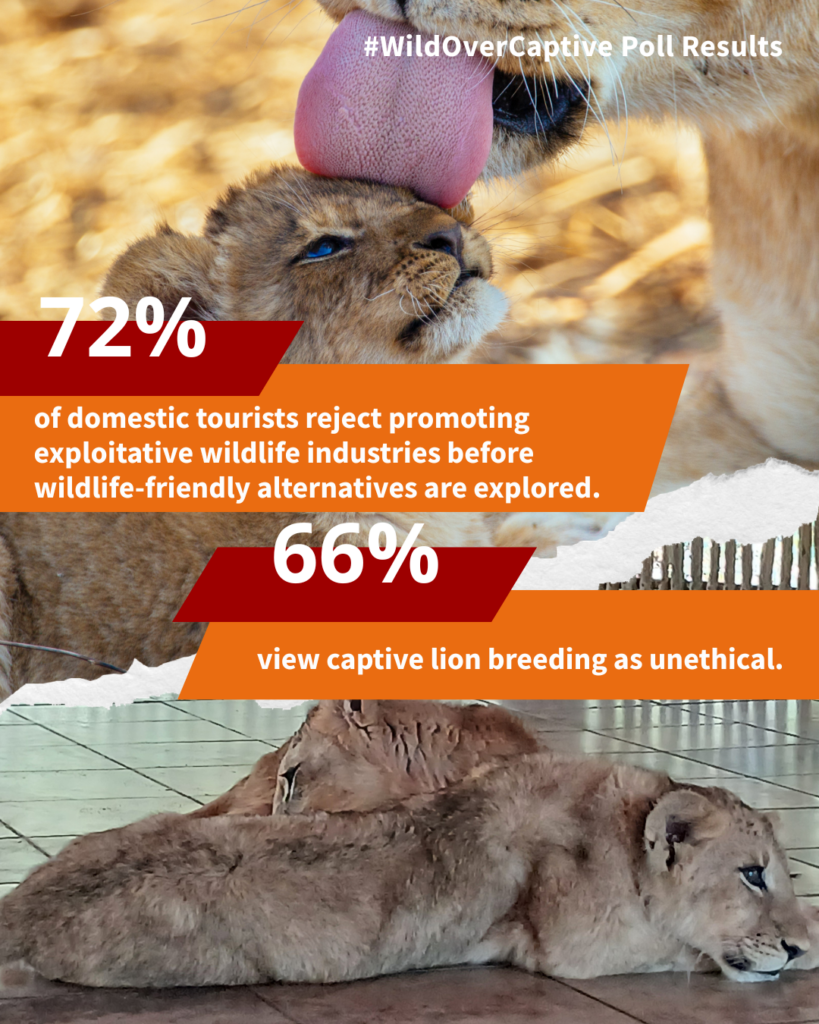
- 72% reject promoting exploitative wildlife industries ahead of wildlife-friendly tourism alternatives.
- 66% say commercial captive lion breeding is unethical.
- 66% believe it would be unacceptable to risk tourism demand.
- 63% warn that reversing the phase-out would undermine trust in evidence-based governance.
- 57% believe banning captive lion breeding would make South Africa more attractive and economically stronger.
Lion welfare emerged as the strongest motivator for supporting the phase-out, cited by nearly half of those respondents who agree with the government’s decision.
“South Africa’s commercial captive lion industry has been proven to be deeply problematic, creating issues aroundreputational damage, ethical and animal welfare concerns and zoonotic diseases. Our new polling data shows that failing to end this industry also risks serious harm to our vital tourism industry. We call on Minister Willem Aucamp to end the delays and uncertainty and urgently deliver the promised phase-out of this industry.
Dr Louise de Waal, Director of Blood Lions.