What does science tell us about depression in animals?

What does science tell us about depression in animals?

While many stakeholders in the commercial wildlife industry believe that animals respond to their environments based on instincts alone, science has demonstrated that animals can experience depression-like behaviours. This information is not new as an early (and highly unethical) study conducted in the late 1960s by Martin Seligman, an American psychologist, showed that dogs subjected to unavoidable electrical shocks gave up trying to escape their environments after repeated exposure. The phenomenon was termed ‘learned helplessness’ and became an important model for understanding depression in humans and animals. 

What does ‘learned helplessness’ mean?

‘Learned helplessness’ occurs when an animal is repeatedly exposed to stressful situations outside of their control. Eventually these animals cease trying to escape their situations. Sadly, even when escape from long-term and repeated exposure to a stressful situation eventually stops, animals experiencing ‘learned helplessness’ may not even attempt to escape. 

How does this relate to depression in animals?

Although Seligman’s study was extremely cruel and unethical, the concept of ‘learned helplessness’ became an important model for understanding the behavioural responses of people (and animals) to depression. It’s a powerful indication that chronic, uncontrollable stressful situations can lead to severe and lasting behavioural and neurochemical changes. 

‘Learned helplessness’ can be seen in passive behaviour, a lack of motivation, and feelings of pessimism that things will never change for the better. In animals, scientists have found that those who display signs of ‘learned helplessness’ even have altered brain chemistry and behaviours similar to people experiencing depression. 

Do animals in captivity experience depression and learned helplessness?

Science shows that wild animals kept in captivity can experience severe environmental deprivation, a lack of control, and long-term exposure to stress, all of which can lead to depression-like behaviours associated with ‘learned helplessness’, such as the following:

Animals showing signs of depression actually mirror what we see in humans experiencing depression, including neurochemical changes in serotonin (implicated in depression) and cortisol (the stress hormone), and neurological changes in brain function and structure. 

What does depression look like in captive animals?

The general public often miss the signs of depression in animals kept in captivity, but the following are strong indicators that an animal is experiencing chronic stress and ‘learned helplessness’:

Animals kept in captivity show these behaviours because captive environments do not provide mental and physical stimulation, they feel isolated from members of their own species, and because they simply cannot escape their stressful environments. 

What does this mean for the welfare of predators kept in captivity?

Captive facilities are by their very nature artificial environments that confine and restrict an animal’s ability to engage in natural behaviours. For predators, like lions and tigers, one of their most inherent behaviours – hunting – is impeded. They are robbed of their ability to roam their territories, hunt prey, and socialise with their own species in ways that are natural to them. Predators kept in captivity often exhibit signs that their environments are harming their well-being and quality of life. By supporting commercial captive facilities, we are failing to genuinely consider wild animals’ quality of life. Even if overt cruelty and neglect is not occuring in a commercial captive facility, captive predators quietly endure stressful and inadequate conditions from birth to death. One or two negative conditions may not feel harmful to the animal’s overall welfare state, but the cumulative impact over its entire life can turn into serious depression and severely affect a captive animal’s quality of life.  

I want to see a big cat up close, but should I?

How can we tell if a captive facility is one that we should support or avoid? With so many predator parks calling themselves sanctuaries or claiming to rescue their animals, how can we be certain that the facility is ethical or not?

South Africa has close to 400 captive predator parks, most of which are purely commercial, or at a minimum designed to earn a profit from their animals. This has resulted in an rampant industry that keeps approximately 8,000 lions, 600+ tigers, 500 cheetahs, 300 leopards, and 1,000s of other predators all in captivity. 

To help you better understand what unethical and profit-driven predator parks look like, read on to learn more about the captive Red Flags


Comments on the Draft Notice Prohibiting Certain Activities Involving African Lion (Panthera leo)

The Director-General: Department of Forestry, Fisheries and the Environment
FAO: Ms Magdel Boshoff
Private Bag X447
Pretoria 0001

Delivered by email to: revisedlionprohibition@dffe.gov.za 

19 November 2024

Comments on the Draft Notice Prohibiting Certain Activities Involving African Lion (Panthera leo)

Dear Ms Boshoff,

Thank you for the opportunity to comment on the Draft Notice prohibiting certain activities involving African lion (Panthera leo), gazetted under notice 51581.

We are in full support of the Minister’s decision to implement appropriate and necessary measures to avoid the establishment of new captive lion facilities whilst the voluntary exit process is underway and legislation under consideration to phase out the commercial captive lion industry in South Africa. 

Blood Lions is in full support of the following issues: 

  1. With regards to captive lions, we fully support the initiative to prohibit the establishment and registration of any new breeding, exhibition or rehabilitation facility or any other type of captive lion facility. This initiative is a positive step towards preventing any further growth of the captive lion industry. 
  2. We support the inclusion of ecological reasons to stop the domestication of lions and move towards a future in which South Africa holds no lions in captivity. As outlined in the prohibition notice, apex predators have complex needs, including social organisation, diverse diet, hunting behaviour, and territorial nature, that are central to their overall welfare and well-being. These complex needs are best provided for in natural environments and functioning, self-sustaining ecosystems. 

The recognition that controlled environments cannot adequately account for the complex needs of these apex predators is an important and necessary step towards phasing out the commercial captive lion industry. It demonstrates the Minister’s progressive recognition of in-situ biodiversity conservation, animal well-being and the need to restore South Africa’s reputation as a leader in the conservation of wildlife and as a responsible tourism destination with iconic wild lions.

Blood Lions have concerns with regards to the following issues: 

  1. The exclusion to establish and register a new sanctuary. Even though the proviso has been made that the Minister should determine that such a new sanctuary is necessary to accommodate sterilised captive lions arising from the voluntary exit process, we feel that this exclusion can be used as a loophole.

Any commercial captive lion facility could potentially register their commercial captive lion facility as a sanctuary, especially since permits are issued on a provincial rather than national basis and the TOPS definition of sanctuary is too ambiguous:

A sanctuary means “a facility that provides permanent care to a specimen of a listed threatened or protected species that would be unable to sustain itself if released in an environment other than a controlled environment, irrespective of the reason for such inability”. This definition specifies neither conditions to guarantee the welfare and well-being of the wild captive animals in such a controlled environment, nor in terms of breeding and/or trading practices. 

If the Minister wants to leave the opportunity open for the establishment of sanctuaries that can accommodate some of the surrendered lions coming out of the voluntary exit process and/or the future prohibition, such facilities should be identified solely as being run under internationally recognised best practices that allow for the welfare and well-being of these apex predators to be guaranteed, as outlined in the various protocols developed by the Ministerial Task Team. 

Currently, numerous commercial captive lion facilities in South Africa have already included the word ‘sanctuary’ within their business name to create the impression that their facility/predator park rescues and/or rehabilitates wildlife, rather than having vested interests in commercial activities. We are concerned that such a loophole may encourage this practice to expand, which would not only deceive the public but also allow commercial activities to continue under the guise of a sanctuary label, and thus leaving the system wide open for abuse. 

2. Our second concern relates to the omission of prohibiting captive breeding of lions at existing commercial facilities. The continuation of captive breeding perpetuates the growth of the captive lion population and the associated animal welfare and well-being implications. This will in turn hamper the phase out process by increasing the number of captive lions that may require veterinary care, sterilisation, potential euthanasia, and/or lion safe haven space. 

It is therefore critical that a moratorium on captive breeding of lions is implemented as soon as possible to expedite not only the voluntary exit but also the ultimate closure of the commercial captive lion industry. 

PRESS RELEASE: World Lion Day

South African NGOs launch awareness campaign ahead of World Lion Day calling for an end to the commercial captive lion industry in South Africa.

“You’re killing them softly” ― a powerful message released for World Lion Day (10 August) by South African NGOs campaigning to bring an expedient end to the commercial captive lion industry in South Africa, a significant move pledged by the South Africa government in 2021. 

The “You’re killing them softly” campaign brings awareness to the fact that any visitor or volunteer paying to play, bottle feed, and/or hand-raise captive-bred predator cubs, use them as photo props, or merely visit predator parks, is fuelling South Africa’s cruel commercial captive predator breeding – and killing – industry. 

World Lion Day 2024

National and international animal welfare and conservation organisations – Blood Lions, FOUR PAWS South Africa, Humane Society International/Africa, and Voice4Lions – have come together as one unified voice this World Lion Day.

“However well-intentioned people’s actions are, these cubs are not orphans, they have no conservation value, they are purely bred to feed an unethical and insidious industry that commodifies these predators,” the group states.

Lions and many other predators are bred solely for commercial purposes, such as cub petting, walking with predators, voluntourism, “canned” or captive trophy hunting, the live trade, and trade in their bones, parts and derivatives.

The dignity of our iconic species has been replaced by the commodification of captive lions and other predators at every stage of their lives. Currently, at least 8,000 lions and thousands of other big cats, including many tigers and cheetahs, are bred and kept at approximately 350 lion farms in South Africa. 

World Lion Day 2024 comes at a significant time for South Africans as we have entered a new Government of National Unity. Across the world, the public and NGOs are appealing to governments to consider the importance of environmental issues in their policies and legislation. 

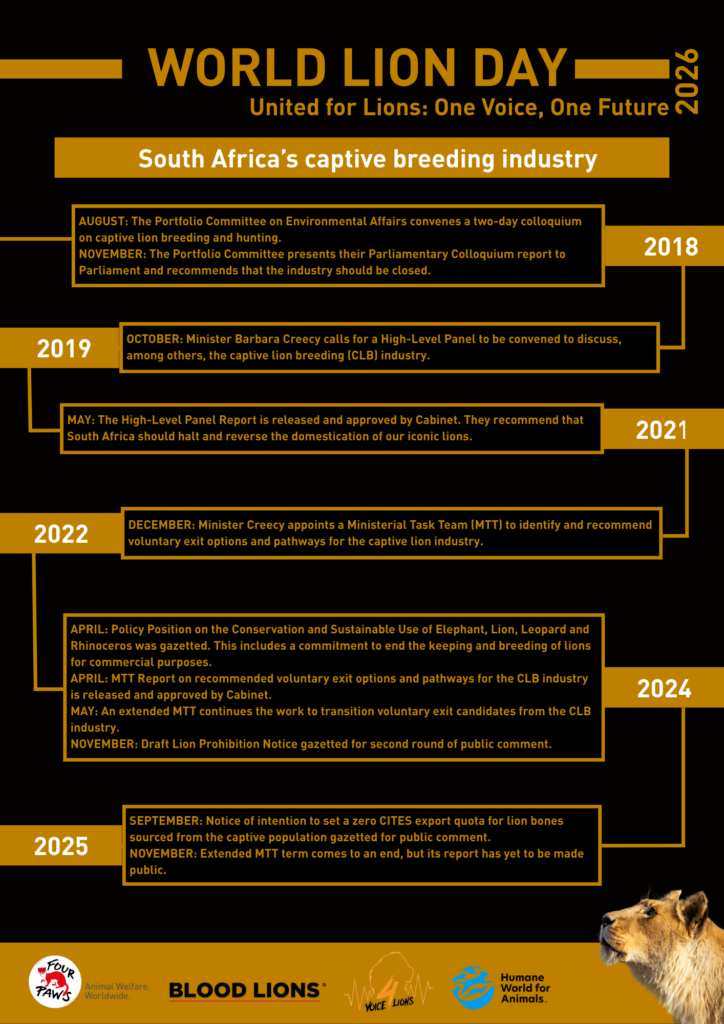
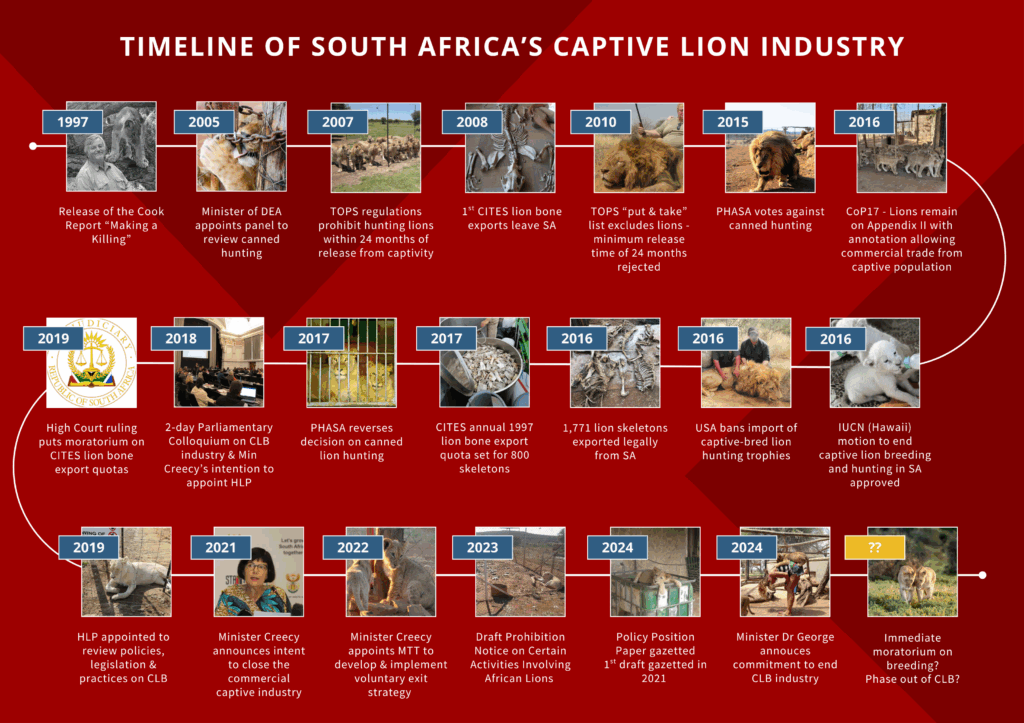
The commercial captive lion industry is one such pressing issue that has garnered substantial attention, leading to a Parliamentary Colloquium in 2018, the formation of the High-Level Panel and subsequent Ministerial Task Team under ex-Minister Barbara Creecy’s leadership. This process led to the commitment of the government to take steps to ultimately close South Africa’s commercial captive lion industry.

“We acknowledge the significant progress achieved and marked by the recently approved report of the Ministerial Task Team on voluntary exit options and the policy position on the conservation of elephants, lions, leopards, and rhinoceroses in South Africa. However, we urge the Department of Forestry, Fisheries, and the Environment (DFFE) to publish a detailed implementation plan with time-bound goals,” the coalition of NGOs say.

World Lion Day 2024

“There is hope to end this cruel and rampant industry and we commend the Cabinet for their commitment. This move will ensure that these majestic animals are no longer bred to suffer for profit. However, we urge the government to ensure the well-being of other predators by extending the ban to all captive big cats and prohibit their ownership as pets and playthings.”

Together, Blood Lions, FOUR PAWS South Africa, Humane Society International/Africa, and Voice4Lions continue to raise vital awareness amongst the public that we are all capable of pushing for meaningful change and ending the exploitation of one of South Africa’s most iconic species. 

The public can make their voices heard by signing the Big Cats SA petition to help urge the DFFE to introduce legislation that prohibits keeping tigers, lions, other big cat species and predators as pets. This legislation should include banning public contact with all big cat species and predators, not just lions, including keeping such species for promotional, educational or entertainment purposes, and interactive experiences like cub petting and walking with big cats. Sign hsi.org/bigcatssa.

Remember, our actions and choices have far-reaching consequences. Let us all work together on World Lion Day to end harmful captive breeding industries and to stop killing them softly.

– END –

World Lion Day 2024 video available HERE

For campaign images check HERE

For more information contact Dr Louise de Waal

Email: management@bloodlions.org 

Phone: (+27) 076 148 1533